Haze and Hype: Which Havana Atmosphere Tricks Actually Work in a British Room
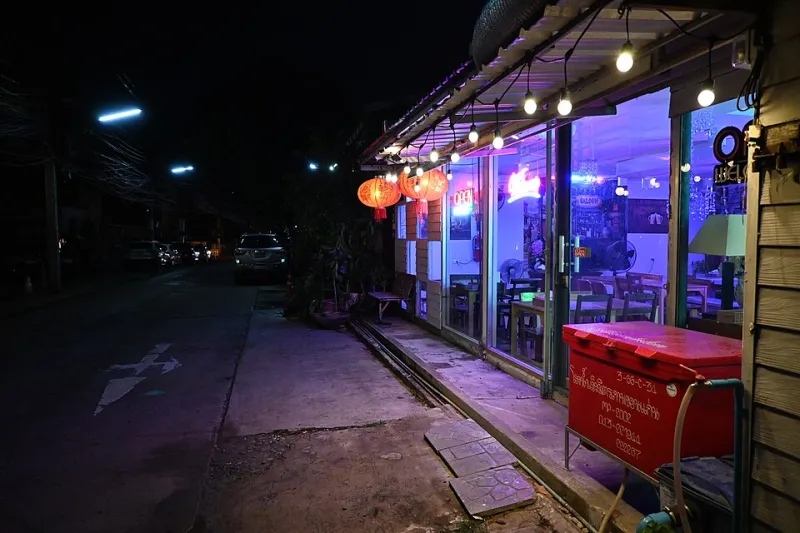
Photo: PattayaPatrol, CC BY-SA 4.0, via Wikimedia Commons
There is a woman in a Bristol basement fanning herself with a menu, and she is the only person in the room who has understood the assignment.
It's 12.40am. The DJ is playing exactly the right record. There are projected palm shadows on a wall, a stack of crates painted to look like a 1950s Chevrolet, and a haze machine doing overtime. The room is not hot. It is not intimate. It is a British basement with some Cuban wallpaper on it, and everyone is standing two feet away from one another waiting to be told what to feel.
I've spent a chunk of this year in rooms like this. Here's the honest scorecard.
First, retire the cigar smoke
England banned smoking indoors in 2007, Scotland in 2006, Wales and Northern Ireland in 2007. If you have seen "cigar smoke" drifting across a UK dancefloor in the last fifteen years, it was glycol and someone's vape. The Havana cliché has been technically impossible for two decades and we are still staging it. Let it go.
That matters more than it sounds, because the cigar-smoke trope is the tell. It signals that a promoter is decorating from photographs rather than from memory. And once you're decorating from photographs, everything downstream gets worse.
The tricks that genuinely work
Lighting, run low and run warm. The single biggest upgrade to any Latin night in this country is a dimmer and the discipline to use it. Havana after dark isn't neon — it's one warm bulb over a doorway, a strip of light under a shutter, and a lot of things you can't quite see. In practice that means 2400–2700K, tungsten or amber LED, everything below 40% after midnight and one deliberate pool of light over the bar so people can find each other. Rooms that spend their budget on a moving-head rig and then blast it at full white are doing the opposite of atmosphere.
Haze, blended, not blasted. A hazer on a low constant output is worth ten smoke machines on a trigger. It softens beams, gives the air a body and makes a low ceiling feel like a ceiling in a film rather than in a function room. Get the venue's sign-off first — optical beam smoke detectors in older buildings will absolutely have opinions about this, and a mid-set fire alarm is the least atmospheric thing on earth.
Air movement. Wildly underrated. Ceiling fans, pedestal fans angled across the floor, not down onto people. What this does is psychological as much as physical: air that moves makes a room feel inhabited, warm, lived-in, like a place with a front door that has been open all evening. Air conditioning that blasts cold is the enemy. Cold rooms do not dance.
A room plan with no dead corner. The Havana reference isn't really about décor — it's about density. Rooms built around a central floor with seating that faces it, a bar you can lean on for four minutes without being moved along, and sightlines from the back that let people decide whether they're staying before they commit. Crates and curtains don't give you that. Layout does.
Where it tips into theme park
You know it when you see it, and it always involves an object that has been looked at for four seconds but never for four hours.
Painted vintage cars. Rattan everything. Projected palm trees on a bare white wall. A staff member in a costume who has been told to say "bienvenido" and looks like they'd rather be anywhere else. Signage in Spanish with a spelling mistake nobody caught. A tropical scent diffuser fighting the smell of a cellar.
The test is simple. Does this thing improve minute 200 of the night, or only minute 2? Almost all the expensive props fail it.
The British constraints nobody budgets for
Haze needs approval. Rigging points are rare in the sort of low-ceilinged basements that make the best Latin rooms. Noise conditions on the licence — and, in a growing number of cases, planning conditions attached to the building rather than the business — will govern your sub-bass whether you like it or not. Capacity limits mean the intimacy you're chasing has a hard legal ceiling, and no amount of fabric drapery will change a fire officer's mind.
Which is why the most useful thing I can tell you is that the atmosphere spend is nearly always misallocated. Four good pedestal fans, a decent hazer, a dimmer rack and one warm light source will cost you less than £600 and will outperform six grand of set dressing every single time.
What I'd buy tomorrow
- Everything on a dimmer. Nothing at full. Ever.
- One warm key light per space, positioned to make people look good rather than to illuminate the room.
- Movement in the air, running from doors open to doors shut.
- Somewhere to sit that isn't the smoking area, because the people who sit down at 1am are the people who are still there at 3am.
Havana after dark was never a set. It was a temperature — a city that stayed out because staying out was the only thing to do, in rooms that were already warm and already full of people who knew each other.
You cannot import that. You can, however, stop putting plastic cars in the way of it.
Last Nights of Havana covers club culture, Latin sounds and going-out inspiration for UK readers.