Brass After Bedtime: The UK Rooms Betting on Live Horns to Save Latin Nights
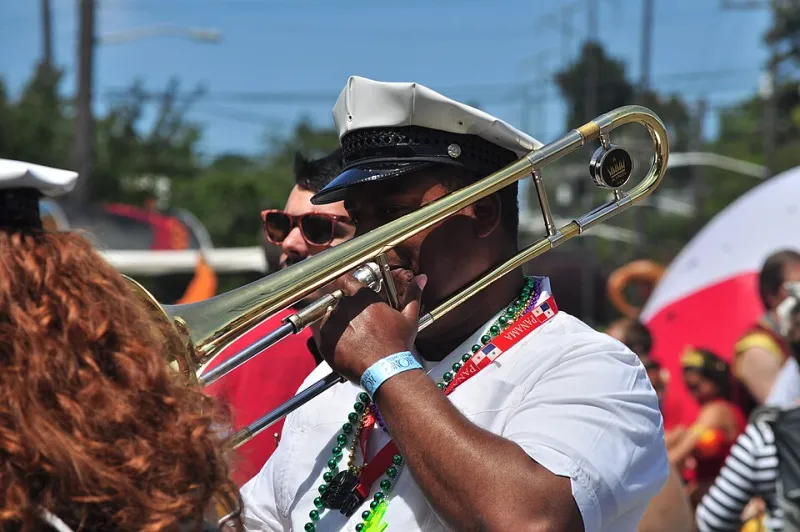
Photo: Joe Mabel (on Flickr as Joe Mabel from Seattle, US), CC BY-SA 3.0, via Wikimedia Commons
There is a moment, usually somewhere after 2am, when a DJ-only Latin night runs out of tricks. The drops still land, the congas still crackle, but the room starts to coast. Then someone wheels a trombone onto the stage, the first notes bark out over the bar, and the floor remembers why it came. That moment is becoming the central sales pitch for a new wave of UK promoters who are adding live brass to Havana-inspired club nights — and not as a gimmick before the headline set.
The Difference Between a Track and a Trombone
A recorded horn line is reliable. It is also fixed. A live section breathes with the room, drags a little when the crowd is heavy, pushes when the dancers are ready. In a Latin context, that matters more than in most club formats. Salsa, son, timba and the broader Caribbean diaspora sounds are built on conversation — call-and-response between voices, percussion and horns. When the brass is in the building, the conversation becomes three-dimensional.
Promoters in Manchester, Leeds, Bristol and London have been testing this idea through 2026. Some book a full five-piece section; others start with a trio of trumpet, trombone and sax. The results are rarely subtle. A horn line gives dancers a target. It also gives a room a shared focus that a laptop and a controller cannot always provide.
What It Costs to Put Brass on Stage
Let’s not pretend this is cheap. A decent three-piece horn section for a late slot can cost more than the DJ fee. A five-piece with arrangements and a rehearsal adds another tier. Then there is the boring stuff: green-room space, monitoring, soundcheck windows that do not clash with the club’s early doors, and the simple fact that brass players need somewhere to leave a case without it being kicked down a fire exit.
The promoters making it work tend to treat the horns as part of the production, not a bolt-on. They build the night around two or three live windows rather than one long set. They keep the section close to the floor, not hidden behind a barrier. And they accept that the DJ’s job changes when the brass is on — the selector becomes a bridge, keeping the energy steady while the players reset, rather than trying to outgun them.
Three Rooms Getting It Right
The Cobalt Room in Manchester’s Northern Quarter has been running a monthly Friday called Brass & Baile. The format is simple: a DJ warms the room until midnight, a four-piece horn section joins for two twenty-minute bursts, and the last hour returns to records. What works is the spacing. The horns are not asked to carry the whole night. They arrive like a guest, not a rescue mission.
In Leeds, Mesa Baja has taken a different route. Its Saturday sessions use a smaller trio and lean into son and bolero before the tempo lifts. The brass is quieter, more conversational, and the crowd is encouraged to dance close rather than holler. It is a reminder that live horns do not have to mean maximum volume. They can mean maximum attention.
Bristol’s La Cantina has the most ambitious setup of the three: a five-piece section, arrangements written for the room’s regular dancers, and a strict no-phones-on-the-floor policy during live windows. The result feels less like a gig and more like a party that happens to have a band in the corner. That distinction matters. A gig audience watches. A dancefloor audience answers back.
What to Listen For as a Dancer
You do not need to know the difference between a mambo and a guaracha to notice when live brass is working. Start with the bass. If the low end and the horn stabs are landing together, the room has a spine. If the horns are chasing the percussion rather than sitting inside it, something is out of joint.
Listen for space. Good Latin brass leaves gaps for the congas and the voice. A section that plays every bar is a section that is showing off. The best moments often come when the trumpet drops out and the trombone slides in behind the clave. That is not a detail for musicians only. Dancers feel it in their shoulders.
And watch the floor, not the stage. When the horns come in, do people turn towards the band or keep dancing? The ideal is a bit of both: a quick glance, a grin, then back to the partner or the circle. If the whole room stops to watch, the balance is off. If nobody notices, the brass is too far back in the mix.
The Antidote Argument
DJ-only Latin nights are not the enemy. Some of the best rooms in the UK run on a single selector and a serious record bag. But there is a growing appetite for something that cannot be playlisted, streamed or replicated by a rival promoter with the same files. Live horns are expensive, awkward and hard to scale. That is precisely why they are becoming the strongest argument in the room.
After midnight, when the crowd has thinned to the dancers who mean it, a trombone can do something a track cannot: it can make the night feel unrepeatable. In a UK scene that often sells atmosphere as a backdrop, that is worth the extra invoice. The brass is not saving Latin nights on its own. But it is giving them a voice that a speaker stack cannot fake.